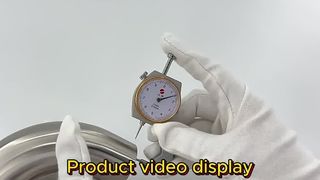
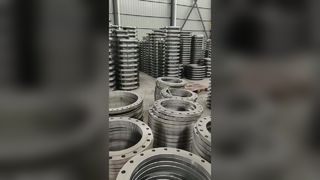
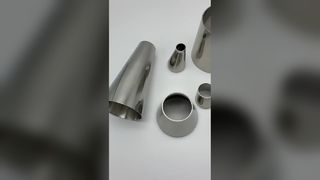
Brief: This video demonstrates the setup, operation, and key moments during typical use of the Premium-grade Slip-On Flange with Neck. You'll see how the two-part system, consisting of a stub end and backing flange, enables perfect bolt hole alignment and simplifies installation in tight spaces or systems requiring frequent disassembly.
Related Product Features:
The system consists of a stub end and a backing flange, allowing the flange to rotate freely for perfect bolt hole alignment.
The backing flange is a flat ring with a raised face and a low hub with a rounded bore to accommodate the stub end.
The stub end is butt-welded to the pipe and features a lap to match the flange face for a secure seal.
Components conform to ASME B16.9 and B16.5 standards for dimensions and are available in all pressure classes from Class 150 to Class 1500.
Available in a wide range of sizes from DN15 to DN2000 (½" to 80") to suit various piping system requirements.
Ideal for expensive alloy or lined piping systems, reducing costs by using a carbon steel backing flange with an alloy stub end.
Perfect for systems requiring frequent dismantling for cleaning or inspection, such as in food processing and pharmaceutical industries.
Simplifies maintenance and reduces friction and wear on flange faces during bolt-up, enhancing system longevity.
Faqs:
What are the main components of the Alloy Steel Lap Joint Flange system?
The system consists of two parts: a stub end, typically made from a high-grade alloy like ASTM A403 WP316, which is butt-welded to the pipe, and a backing flange, often made from cost-effective carbon steel like ASTM A105, which rotates freely around the stub end.
What are the key advantages of using a lap joint flange?
Key advantages include significant cost savings by pairing an alloy stub end with a carbon steel backing flange, elimination of bolt hole alignment issues due to the flange's free rotation, reduced friction and wear during assembly, and simplified maintenance and inspection in systems requiring frequent disassembly.
In which applications is the Lap Joint Flange system most suitable?
This system is ideal for expensive alloy or lined piping systems, such as those using stainless steel, duplex, or nickel alloys. It is perfect for industries like food processing, pharmaceutical, and pulp & paper, where frequent dismantling for cleaning or inspection is required, and in cramped spaces where rotating the entire pipe assembly is difficult.